You have the form, the reference number and enough time. You still haven't opened it. A friend offers to sit with you while they work on something of their own.
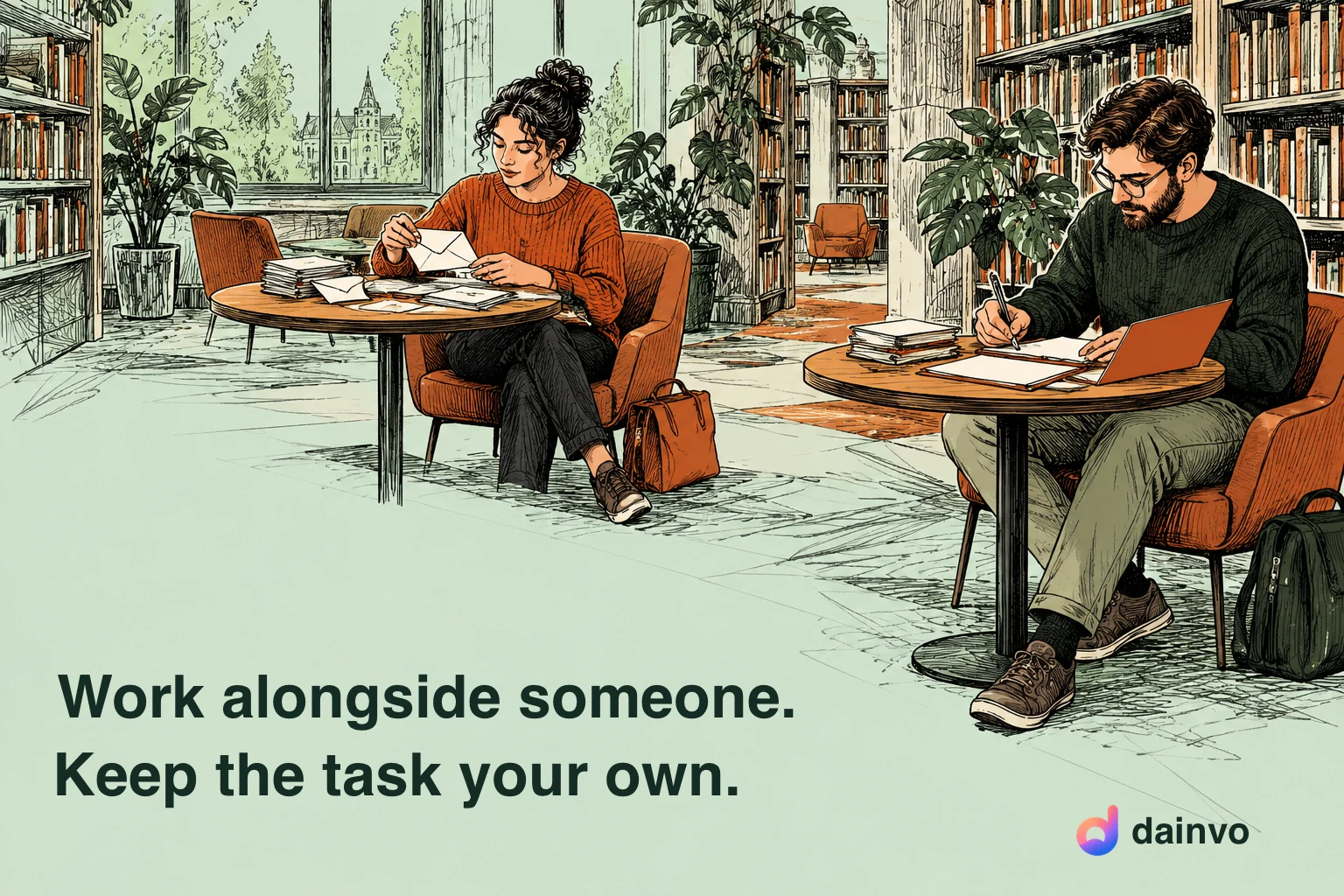
That arrangement is often called body doubling. The Attention Deficit Disorder Association describes sessions where people work alongside one another on separate tasks. It is an option to try, rather than a promise that another person's presence will make every difficult task manageable.
An admin session needs an agreement about the work and the company. That is especially useful when the task involves private information, an unfamiliar form or a submission you cannot undo. Decide what you want the other person to do before you invite them.
Ask for a specific kind of company
"Help me get organized" can leave your friend responsible for decisions you meant to make yourself. Ask for the part that would help now.
You could say: "Would you work beside me for half an hour on Thursday? I want to open the renewal form and find out which documents it needs. You can do your own work. I don't need you to check mine."
Agree on whether you'll talk at the start, work quietly or check in partway through. If company turns into conversation, that agreement gives you a way to return to the work without making either person the supervisor.
Your partner should be able to decline or suggest another time. A shared session works better as an agreement than an obligation someone discovers after joining the call.
Choose a result that fits the appointment
"Clear my admin" has no obvious finish. "Find the documents needed for the renewal" gives you a result you can check.
If the whole form is unfamiliar, the first session may be for understanding it. You can discover a missing document and still have used the time well. Record what you need and decide how to obtain it.
Before the session, gather what you can without turning preparation into a separate project. Keep the form link, reference number and relevant file in one place. Check that you can access the account yourself. Your partner doesn't need your password to work beside you.
For several small jobs, make a short list in advance. Put the one you keep avoiding near the beginning, if that's what you want company for. Otherwise, a set of easy emails can consume the session while the form remains closed.
Set privacy and interruption rules
Separate work doesn't require shared screens. If you're handling financial, medical, employment or family information, keep it private. Use headphones if you need to make a call, and agree whether stepping away is fine.
You can say the task in broad terms without explaining its contents. "I need to complete a form" can be enough. Don't record another person or their workspace without their agreement.
For a virtual session, decide whether cameras are useful and what happens if a connection drops. Avoid treating a disconnected call as a failure that requires restarting the whole task.
For an in-person session, choose somewhere the work can happen comfortably. A busy cafe may be suitable for drafting an email and unsuitable for a confidential call.
Leave a short record at the end
Before saying goodbye, write down what happened and what remains. Keep the record about the task rather than a verdict on the session.
For the renewal, that could be:
Opened the application. Address details are complete. Need the reference from last year's letter before submitting. Find the letter on Friday.
If the task is finished, check the confirmation or saved result before marking it done. Another person's company doesn't change the submission requirements.
You can use a notebook for the session list. In Dainvo, a Bucket can hold several tasks in one work session and link local files. It stores references to those files rather than uploading them. Buckets are available on Free desktop; cross-device Bucket sync requires Pro. Dainvo doesn't supply a body-doubling partner or monitor either person's attention.
Change the arrangement if company isn't helping
You might work more easily alone, with a quieter partner or in a shorter session. You might need help understanding the form rather than someone beside you. Ask for that distinction instead of booking more of the same sessions.
ADDA's background article distinguishes practical reports from a proven scientific explanation. Treat your session as information about what helps you do this work. It isn't a test of how well you manage ADHD, and it doesn't replace professional support when you need it.
Have a plan for a missing partner
Decide whether you want to continue alone if the other person cancels. You might open the form and note its requirements, or move the session to a time when support is available. Avoid making a friend's attendance the only way to find the task again. Keep the link and next action in your own notes.
If what you need is advice about an official form, ask the organization that issued it or an appropriate adviser. Quiet company and expert help serve different purposes.