
Sunsama and Dainvo are both built for people who want planning to feel calmer.
That makes this comparison different from the usual productivity app matchup.
Sunsama is not trying to be a noisy task manager. Its official messaging is built around calm planning, focus, healthy work habits, shutdown rituals, analytics and realistic workloads.
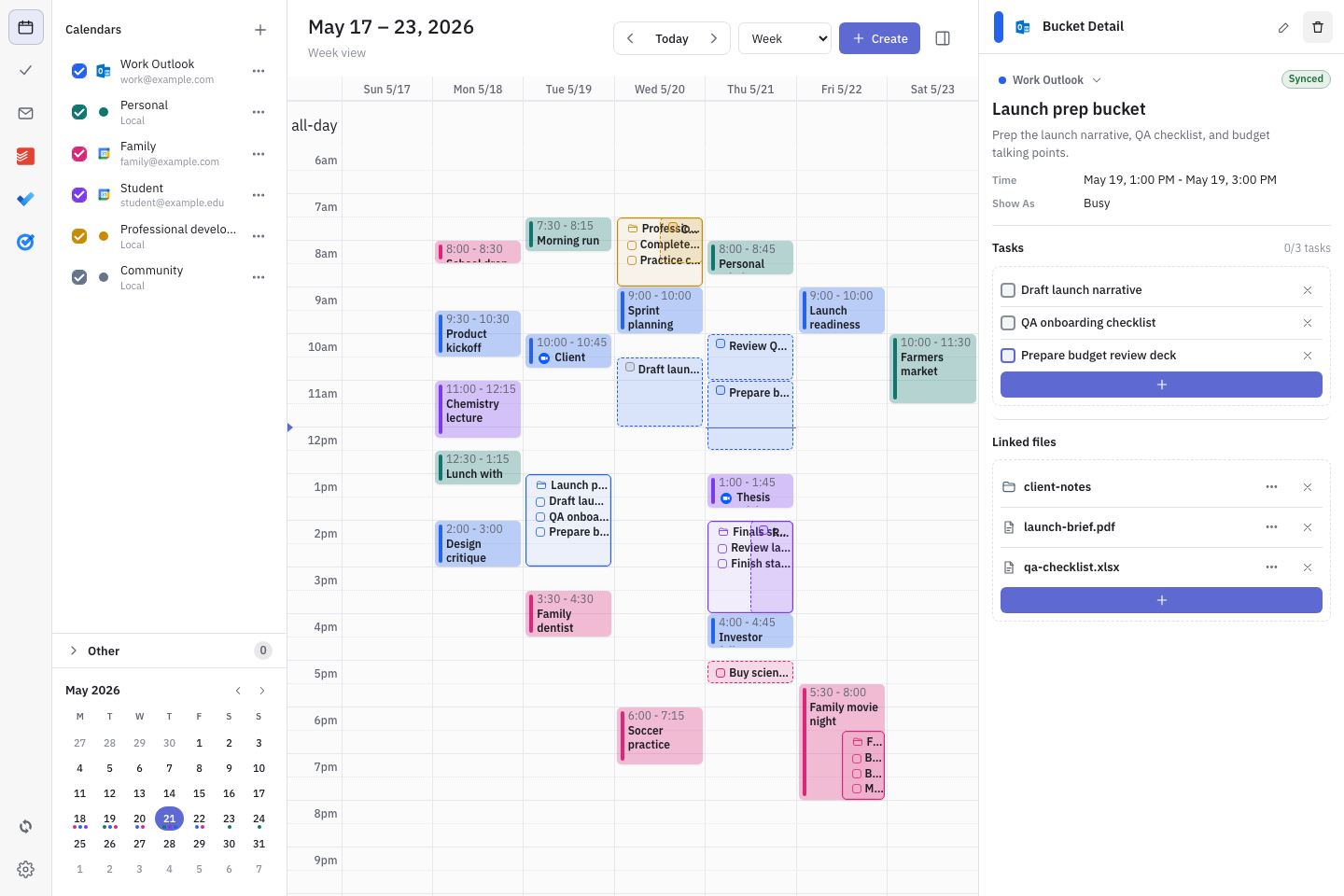
Dainvo takes a simpler route. It brings calendars, tasks, meeting links and work files together so you can see the day, plan what matters, and open the right thing when it is time to work.
So the question is not "Which app is calmer?"
The better question is:
Do you want guided planning rituals, or do you want a simpler one-place planning layer?
Sunsama is built around morning planning, shutdown, focus support and work habit guardrails.
Dainvo is built around calendars, tasks, meeting links and files in one place at a lower starting price.
Quick verdict
| You are | Better fit | Why |
|---|---|---|
| A user who wants guided daily rituals | Sunsama | Sunsama's daily planning flow walks users through reflection, task selection, workload checks, timeboxing and shutdown. |
| A user who just wants calendars, tasks and meetings together | Dainvo | Dainvo is more directly focused on one-place day planning with calendars, tasks, meeting links and files. |
| A user who cares most about price | Dainvo | Dainvo Pro is available at the $5/month launch price. Sunsama lists $17/month billed yearly or $22/month billed monthly. |
Sunsama is the stronger fit if you want a premium ritual-led planning system. Dainvo is the stronger fit if you want calm planning with less overhead and a lower monthly cost.
Planning philosophy: calm rituals vs practical clarity
Sunsama's philosophy is habit-led.
Its product pages emphasize starting the day with clarity, planning a realistic workload, blocking time on the calendar, focusing during the day, seeing where time went, and ending work with a shutdown ritual.
That is a strong approach if your problem is not just scattered tools, but the lack of a reliable daily routine.
Dainvo's philosophy is more direct.
Its homepage leads with practical clarity: bring calendars, tasks, meeting links and work files together, plan what matters, time block it, and open the right thing when it is time to get started.
That is a strong approach if you already know how you like to plan, but your workday is split across too many places.
Sunsama helps you build a planning ritual. Dainvo helps you make the day actionable from one place.
Dainvo vs Sunsama comparison table
| Category | Dainvo | Sunsama |
|---|---|---|
| Main promise | Your whole day in one place | A calm daily planner for focused, sustainable work |
| Best for | People who want simpler integration-led day planning | People who want guided rituals and behavioural guardrails |
| Planning style | See the day, choose what matters, time block and start | Guided daily planning, workload checks, focus support and shutdown |
| Calendar view | See calendars together and block time for important work | Calendar integration and timeboxing are core parts of the workflow |
| Task imports | Dainvo Tasks, Microsoft To Do, Google Tasks, Todoist, TickTick, and Obsidian tasks | Pulls tasks from task and project tools such as Asana, Trello, Jira, Todoist and others |
| Email and message follow-up | Microsoft Teams is current; Outlook Email and Gmail email workflows are not available in the current release | Official pages describe turning emails, Slack messages and Teams messages into tasks |
| Meeting links | Keeps Teams, Zoom and Google Meet links where the rest of the day already lives | Strong meeting and calendar workflow, plus scheduling-link features listed on comparison pages |
| Files | Work files are part of the Dainvo day planning story | Stronger on rituals, task import, calendar planning, focus and analytics than file-first planning |
| Focus support | Supports focus through time blocking and fewer places to check | Focus mode, Pomodoro, app muting, breaks and shutdown routines are part of Sunsama's story |
| Analytics | Not the main public positioning today | Analytics and time-use review are prominent on Sunsama's public pages |
| Price | Pro at the $5/month launch price | $17/month billed yearly or $22/month billed monthly |
| Best fit | Lower cost practical clarity | Premium calm planning with guided habits |
Sources: Dainvo homepage, integrations and Why Dainvo pages; Sunsama homepage, pricing, comparison and daily planning pages.
Where Sunsama clearly wins
Sunsama should win for users who want the planner to shape their behaviour.
Its daily planning workflow is deliberately guided. Sunsama's manual describes a flow that includes reflecting on yesterday, adding tasks, checking predicted workload, finalizing the plan and optionally sharing the plan.
That structure is useful for people who overcommit, skip planning, forget to shut down, or need stronger boundaries around their workday.
Sunsama also has the stronger story for:
- Daily planning rituals
- Daily shutdown and highlights
- Focus mode and Pomodoro
- Workload warnings
- Time-use analytics
- Broader project and message-based task imports
If you want a premium calm-planning system that teaches a healthier workflow, Sunsama is the more mature choice.
The Dainvo alternative case
Dainvo makes sense when Sunsama feels like more ritual than you need.
Some users do not want a planner to walk them through a morning and evening process. They do not need workload analytics, a shutdown ritual or a larger habit system.
They want one clear place to answer practical questions:
- What is happening today?
- Which tasks need time?
- Where is the meeting link?
- Where is the file I need?
- Can I see work, study and personal time together?
Dainvo is built around those questions. Its public pages focus on calendars, tasks, meeting links, files, time blocking and current integrations with the tools people already use.
That is why Dainvo can be a strong Sunsama alternative for people who want calm planning, but not a premium ritual layer.
Workflow comparison
Sunsama workflow
- Reflect on yesterday
- Pull in tasks from your tools
- Check your predicted workload
- Timebox work and finalize the plan
- Focus during the day and shut down intentionally
Dainvo workflow
- Bring calendars, tasks, meetings and files together
- See the day in one place
- Choose what matters
- Block time for the work
- Open the right link or file and start
Sunsama is better when you want a guided planning habit.
Dainvo is better when you want fewer places to check before execution.
Calendar, tasks, meetings and files
This is where the tools feel most different in practice.
Sunsama is excellent at turning a day into a structured ritual. It helps you decide what belongs in today, warns when the workload is too high, and supports focus with tools like Pomodoro, focus mode and shutdown.
Dainvo is more focused on making the actual workday easier to assemble.
Your calendar is one part of the plan. Your tasks are another. Your meeting links are another. Your files are another.
Dainvo's advantage is keeping those pieces closer together without asking users to adopt a larger ritual stack.
Price and value
Sunsama is a premium planner.
Its pricing page currently says Sunsama costs $17/month when billed yearly, or $22/month when billed monthly.
That price can make sense if Sunsama changes how you work. If the rituals help you avoid overcommitment, end the day on time and stay focused, the value is real.
Dainvo is easier to justify for users who mainly want the practical planning layer.
Dainvo Pro is available at the $5/month launch price and includes access to all integrations, unlimited calendar sync, task app sync, file connections and meetings in one place.
That makes the value split clear:
Choose Sunsama if you will use the rituals. Choose Dainvo if you want the core one-place planning job at a lower cost.
Students and busy professionals
Dainvo has a strong case for people switching between work, study and personal contexts.
Dainvo's homepage specifically talks about seeing work, study and personal time together. That matters for students, freelancers, solo professionals and busy people who do not live inside one clean work calendar.
Sunsama can still be the better fit if you need the accountability of a daily ritual. If you often overplan, work too late, or need more behavioural guardrails, Sunsama's structure may help.
Dainvo is the cleaner fit if your main issue is scattered context: one calendar here, tasks there, a meeting link in an invite, and a file saved somewhere else.
Choose Sunsama if
Choose Sunsama if you want:
- Guided daily planning
- A daily shutdown ritual
- Workload checks and healthier work boundaries
- Focus mode, Pomodoro and break support
- Analytics for where your time went
- Broader task imports from project and message tools
- A premium calm-planning system you use every workday
Sunsama is the stronger choice if your planning problem is partly behavioural.
Choose Dainvo if
Choose Dainvo if you want:
- A simpler Sunsama alternative
- A lower monthly cost
- Calendars, tasks, meetings and files in one place
- Time blocking without a full ritual layer
- Meeting links and files ready when work starts
- A planner that works with supported Google, Microsoft, Apple, CalDAV, Todoist, TickTick, Obsidian, Zoom, Teams, Meet, or Webex tools
Dainvo is the better fit if your planning problem is practical clarity.
Keep your current stack if
You may not need either app if your current system already works.
Keep your current stack if:
- You plan every day without friction.
- Your calendar and task app stay aligned.
- You do not lose time hunting for meeting links or files.
- You do not need guided planning rituals.
- You do not need a new central place for the workday.
A daily planner should reduce friction. If it adds more work than it removes, it is not the right tool yet.
Final verdict: Sunsama for rituals, Dainvo for practical clarity
Sunsama is great for guided planning rituals.
It is a premium planner for people who want help planning calmly, protecting focus, reviewing time and shutting down with intention.
Dainvo is better for people who want calm planning with less overhead.
It gives you one place for calendars, tasks, meeting links and files, without asking you to adopt a full ritual stack.
See if Dainvo gives you the calm planning you want without the premium overhead.
Try DainvoFAQ
Is Dainvo a Sunsama alternative?
Yes. Dainvo is a Sunsama alternative for people who want calendars, tasks, meeting links and files in one place without adopting a full guided ritual system.
Is Dainvo cheaper than Sunsama?
Yes. Dainvo Pro is available at the $5/month launch price. Sunsama's pricing page currently lists $17/month billed yearly or $22/month billed monthly.
Does Sunsama have stronger planning rituals than Dainvo?
Yes. Sunsama is stronger if you want guided daily planning, workload checks, daily shutdown, focus tools and analytics. Dainvo is positioned more around practical clarity and one-place day planning.
Who should use Sunsama instead of Dainvo?
Use Sunsama if you want a premium calm-planning system with guided rituals, focus support, shutdown habits and time-use analytics.
Who should use Dainvo instead of Sunsama?
Use Dainvo if you want a lower cost planner that keeps calendars, tasks, meeting links and files together so your day is easier to plan and start.
Does Dainvo work with Todoist and Microsoft To Do?
Yes. Dainvo supports Todoist and Microsoft To Do, along with Google Tasks, TickTick, and Obsidian tasks. Supported calendars include Google, Outlook, Apple, and CalDAV. Gmail is not available in the current release.
Does Dainvo work with Zoom, Teams and Google Meet?
Yes. Dainvo lists Zoom, Microsoft Teams and Google Meet as current integrations, along with Webex.